Lower Back Pain Treatment: How Physical Therapy Delivers Lasting Relief in Midtown Manhattan


Living With Lower Back Pain in New York City: You’re Not Alone
If you’ve ever winced while stepping off a crowded subway car, struggled to sit through a full day at your desk in a Midtown office tower, or felt a sharp catch in your back while carrying groceries up a fifth-floor walkup, you understand how lower back pain can infiltrate every corner of your daily life. In a city that demands constant movement — fast walking, stair climbing, standing on packed trains — lower back pain doesn’t just hurt. It slows you down in a place that never slows down for anyone.
Lower back pain is the single leading cause of disability worldwide, according to the Global Burden of Disease study, and it affects an estimated 80% of adults at some point in their lives. Here in New York City, the combination of sedentary desk work, high-stress lifestyles, and demanding physical environments makes the problem even more prevalent. The good news? Physical therapy is consistently supported by research as one of the most effective, non-invasive, and long-lasting treatments available — and at LIM Physical Therapy PC in Midtown Manhattan, New York, we see these outcomes firsthand every single day.
This comprehensive guide will walk you through what lower back pain actually is, why it happens, what the latest evidence says about treatment, which exercises and techniques work best, and when it’s time to seek professional help.
What Is Lower Back Pain?
Lower back pain — clinically referred to as lumbago or lumbar spine pain — is pain, stiffness, or discomfort felt in the region of the spine between the bottom of the rib cage and the top of the pelvis. The lumbar spine consists of five vertebrae (L1–L5) and supports the majority of your upper body weight. It is a complex structure involving bones, intervertebral discs, ligaments, tendons, muscles, and a dense network of nerves branching from the spinal cord.
Lower back pain is broadly categorized into three types:
- Acute lower back pain: Lasting less than four weeks, often triggered by a specific incident such as lifting something heavy or a sudden awkward movement.
- Subacute lower back pain: Lasting between four and twelve weeks, representing a transitional phase that may or may not resolve on its own.
- Chronic lower back pain: Persisting for twelve weeks or longer, even after the initial cause of pain has been addressed. Chronic low back pain often involves a combination of structural, neurological, and psychosocial factors.
It’s important to understand that lower back pain is not a diagnosis in itself — it’s a symptom. Effective treatment depends on identifying the underlying cause, which is precisely where a skilled physical therapist becomes invaluable.
📹 Related Video
Common Causes & Risk Factors
📹 Related Video
Lower back pain can arise from a wide range of mechanical, degenerative, and lifestyle-related factors. The most common causes include:
- Muscular strain and ligament sprain: The most frequent cause, often resulting from improper lifting mechanics, sudden movements, or overuse. This is especially common among New Yorkers who move apartments, carry heavy bags, or jump back into exercise after long sedentary periods.
- Herniated or bulging discs: When the soft, gel-like center of an intervertebral disc pushes through its outer layer, it can compress nearby nerve roots and cause pain, numbness, or weakness radiating into the legs (sciatica).
- Degenerative disc disease: Age-related wear and tear on the intervertebral discs that leads to reduced cushioning, stiffness, and pain.
- Spinal stenosis: A narrowing of the spinal canal that puts pressure on the spinal cord and nerves, most common in adults over 50.
- Facet joint dysfunction: Inflammation or degeneration of the small joints connecting each vertebra, often causing localized pain that worsens with extension or twisting.
- Sacroiliac (SI) joint dysfunction: Pain arising from the joint connecting the sacrum to the pelvis, frequently misdiagnosed as lumbar spine pain.
- Poor posture and ergonomics: Prolonged sitting — particularly in poorly designed office setups — places sustained compressive loads on the lumbar discs and weakens supporting musculature.
Key risk factors include sedentary lifestyle, obesity, smoking, psychological stress, occupational demands (both heavy physical labor and prolonged desk work), age, and prior history of back pain. Notably, research published in The Lancet (2018) emphasizes that psychosocial factors such as stress, anxiety, depression, and fear-avoidance behavior play a significant role in the transition from acute to chronic lower back pain — a factor that comprehensive physical therapy directly addresses.
Evidence-Based Treatment Approaches for Lower Back Pain
The landscape of lower back pain treatment has shifted dramatically over the past two decades. Major clinical practice guidelines — including those from the American College of Physicians (ACP), the American Physical Therapy Association (APTA), and the National Institute for Health and Care Excellence (NICE) — now consistently recommend physical therapy and active rehabilitation as first-line treatments, often before medications, injections, or surgery.
Here’s what the evidence supports:
- Physical therapy and exercise: A 2021 systematic review in the British Journal of Sports Medicine confirmed that exercise therapy significantly reduces pain intensity and improves function in both acute and chronic lower back pain. Structured physical therapy programs are considered the gold standard for non-surgical management.
- Manual therapy: Joint mobilization and manipulation, when combined with exercise, have been shown to produce superior short-term pain relief compared to exercise alone (Journal of Orthopaedic & Sports Physical Therapy, 2017).
- Patient education and self-management: Teaching patients about pain neuroscience — how the brain processes pain signals — reduces fear-avoidance behavior and improves outcomes. This approach, known as Pain Neuroscience Education (PNE), has been validated in multiple randomized controlled trials.
- Graded exposure and activity modification: Gradually increasing activity levels rather than resting has been shown to be far more effective than bed rest, which is now actively discouraged by virtually every major guideline.
- Cognitive-behavioral approaches integrated into PT: Addressing the psychological dimensions of pain — catastrophizing, fear of movement, depression — within the physical therapy framework improves long-term outcomes significantly.
What the evidence discourages: routine imaging (MRI/X-ray) for non-specific low back pain without red-flag symptoms, prolonged opioid use, and early surgical intervention for conditions that haven’t been managed conservatively first.
Physical Therapy Exercises & Techniques for Lower Back Pain
At LIM Physical Therapy PC in Midtown Manhattan, New York, treatment plans are never one-size-fits-all. After a thorough evaluation — which includes a detailed medical history, movement assessment, orthopedic testing, and functional screening — your physical therapist designs a personalized program targeting your specific impairments. Here are the core categories of exercises and techniques commonly used:
Core Stabilization Exercises
The deep stabilizing muscles of the trunk — particularly the transverse abdominis, multifidus, pelvic floor, and diaphragm — act as a natural “corset” for the lumbar spine. Research consistently shows that motor control exercises targeting these muscles reduce recurrence rates of lower back pain by up to 50%. Examples include dead bugs, bird-dogs, pelvic tilts, and diaphragmatic breathing drills.
Lumbar Mobility and Flexibility Work
Restoring pain-free range of motion is a critical early goal. Gentle lumbar flexion and extension exercises (such as cat-cow stretches and press-ups), hip flexor stretches, hamstring lengthening, and piriformis stretches help reduce stiffness and improve movement quality.
Strengthening Programs
Progressive loading of the gluteal muscles, spinal erectors, quadriceps, and hip stabilizers builds the structural support your lower back needs. Exercises like bridges, squats, deadlift variations, and step-ups are introduced progressively based on your tolerance and goals.
Manual Therapy Techniques
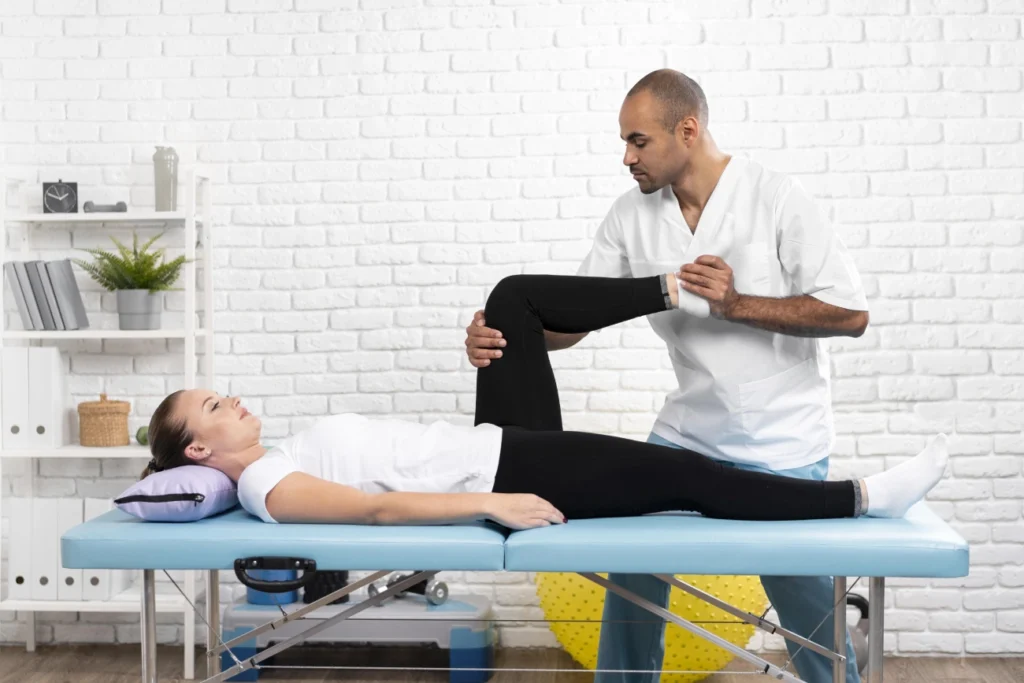
Hands-on techniques such as spinal joint mobilization, soft tissue mobilization, myofascial release, and dry needling can provide significant short-term pain relief and improve tissue mobility, allowing you to exercise more effectively.
Neuromuscular Re-education
Many patients develop compensatory movement patterns to avoid pain. Physical therapists use targeted movement retraining — including gait correction, postural re-education, and functional task training — to restore normal, efficient movement patterns.
Modalities (as adjuncts)
While not standalone treatments, modalities such as electrical stimulation (TENS), ultrasound, heat, and ice may be used as supplementary tools to manage pain and inflammation during the early phases of rehabilitation.
When to Seek Professional Help
Many episodes of acute lower back pain improve within a few weeks with self-care, gentle movement, and over-the-counter pain relief. However, you should seek professional evaluation promptly if you experience any of the following:
- Pain that persists beyond two to three weeks without improvement
- Pain that radiates down one or both legs, especially below the knee
- Numbness, tingling, or weakness in the legs or feet
- Difficulty controlling your bladder or bowels (seek emergency care immediately — this may indicate cauda equina syndrome)
- Pain following a traumatic injury such as a fall or car accident
- Unexplained weight loss, fever, or night sweats accompanying back pain
- Pain that worsens at night or is unrelieved by any position
- History of cancer, osteoporosis, or immunosuppression with new onset back pain
Early intervention with physical therapy has been shown to reduce the likelihood of developing chronic pain, decrease healthcare costs, lower the risk of opioid use, and improve return-to-work timelines. A 2018 study in Health Services Research found that patients who saw a physical therapist within 14 days of low back pain onset had significantly lower total healthcare expenditures over the following year compared to those who delayed treatment.
Don’t wait for pain to become a permanent part of your life. The earlier you act, the better your outcome.
Frequently Asked Questions About Lower Back Pain and Physical Therapy
How many physical therapy sessions will I need for lower back pain?
Is it safe to exercise when my lower back hurts?
Can physical therapy help me avoid surgery for a herniated disc?
Conclusion: Take the First Step Toward a Pain-Free Life
Lower back pain may be common, but it doesn’t have to be permanent. The evidence is clear: physical therapy is one of the most effective, safest, and most cost-efficient treatments available for lower back pain at every stage — from the first twinge to chronic, long-standing conditions. With the right diagnosis, a personalized treatment plan, and consistent effort, the vast majority of patients achieve meaningful, lasting relief.
At LIM Physical Therapy PC in Midtown Manhattan, New York, we combine evidence-based clinical expertise with a patient-centered approach that respects your time, your goals, and the demands of your life in New York City. Whether you’re a desk-bound professional, a weekend warrior, a performing artist, or anyone in between, we’re here to help you move better, feel better, and get back to the life you love.
If lower back pain has been holding you back, don’t wait for it to resolve on its own. Contact LIM Physical Therapy PC today to schedule your evaluation and start your journey toward recovery. Our Midtown Manhattan clinic is conveniently located for patients across New York City — because getting great care shouldn’t be another source of stress.