Lower Back Pain Treatment: How Physical Therapy Delivers Lasting Relief in Midtown Manhattan


Introduction: Why Lower Back Pain Is a Daily Reality for New Yorkers
If you’re reading this while shifting uncomfortably in your office chair somewhere in Midtown Manhattan, you’re far from alone. Lower back pain is the single leading cause of disability worldwide, according to the World Health Organization, and it affects an estimated 80% of adults at some point in their lives. For New Yorkers specifically — people who spend long hours at desks, commute on packed subways, navigate miles of concrete sidewalks, and often live in apartments that double as home offices — the lower back bears an extraordinary burden.
The good news? Physical therapy is consistently ranked among the most effective, safest, and most cost-efficient treatments for lower back pain. At LIM Physical Therapy PC in Midtown Manhattan, New York, we see patients every day who arrive frustrated by persistent back pain and leave with the tools, strength, and knowledge to manage — and often eliminate — their symptoms without surgery or long-term medication use.
This guide will walk you through what lower back pain actually is, what causes it, how physical therapy treats it, and when it’s time to seek professional help.
What Is Lower Back Pain?
Lower back pain (also called lumbago or lumbar pain) refers to pain, stiffness, or discomfort in the region of the spine between the bottom of the rib cage and the top of the pelvis — the lumbar spine. This area consists of five vertebrae (L1–L5), intervertebral discs, a complex network of muscles and ligaments, and the spinal nerves that exit at each level.
Lower back pain is generally classified into three categories:
- Acute lower back pain: Lasting fewer than 4 weeks. Often triggered by a specific incident such as a lifting injury, sudden movement, or fall.
- Subacute lower back pain: Lasting between 4 and 12 weeks. This phase is critical — without proper intervention, subacute pain has a significantly higher risk of becoming chronic.
- Chronic lower back pain: Persisting for 12 weeks or longer, even after the initial injury or underlying cause has been addressed. Chronic lower back pain often involves a complex interplay of physical, neurological, and psychosocial factors.
It’s important to understand that pain intensity does not always correlate with the severity of structural damage. Many people with significant disc herniations on MRI experience no pain at all, while others with “normal” imaging results live with debilitating symptoms. This is precisely why a thorough clinical evaluation by a skilled physical therapist is so essential.
📹 Related Video
Common Causes and Risk Factors
📹 Related Video
Lower back pain rarely has a single cause. More often, it results from a combination of mechanical, lifestyle, and environmental factors. Understanding these causes is the first step toward effective treatment.
Mechanical and Structural Causes
- Muscle strains and ligament sprains: The most common cause of acute lower back pain, often resulting from improper lifting, sudden twisting, or overexertion.
- Disc herniations and bulges: When the soft inner material of an intervertebral disc pushes through its outer ring, it can compress nearby spinal nerves, causing pain that may radiate into the buttocks or legs (sciatica).
- Degenerative disc disease: Age-related wear and tear on spinal discs that leads to reduced cushioning between vertebrae.
- Spinal stenosis: A narrowing of the spinal canal that places pressure on the spinal cord and nerves, more common in adults over 50.
- Facet joint dysfunction: Irritation or arthritis in the small joints that connect each vertebra, causing localized stiffness and pain.
- Sacroiliac (SI) joint dysfunction: Abnormal movement in the joint connecting the spine to the pelvis, a frequently overlooked source of lower back and buttock pain.
Risk Factors Especially Relevant to NYC Residents
- Prolonged sitting: Whether at a trading desk on Wall Street, in a design studio in Chelsea, or working remotely from a kitchen table, extended sitting places sustained compressive loads on the lumbar discs.
- Sedentary lifestyle: Insufficient physical activity leads to deconditioning of the core and spinal stabilizer muscles.
- High-stress occupations: Research published in The Lancet (2018) confirms that psychological stress, anxiety, and depression are independent risk factors for the development and persistence of lower back pain.
- Carrying heavy bags: Daily commuting with heavy laptop bags, groceries, or work equipment creates asymmetric loading on the spine.
- Obesity: Excess body weight increases mechanical stress on spinal structures.
- Age: While lower back pain can occur at any age, risk increases significantly after age 30.
- Smoking: Reduces blood flow to spinal tissues and accelerates disc degeneration.
Evidence-Based Treatment Approaches for Lower Back Pain
Over the past two decades, clinical research has shifted dramatically in how lower back pain is treated. Major clinical practice guidelines — including those from the American College of Physicians (ACP, 2017), the National Institute for Health and Care Excellence (NICE), and the American Physical Therapy Association (APTA) — now recommend physical therapy and active rehabilitation as first-line treatments for lower back pain, ahead of imaging, opioid medications, and surgery in most cases.
Key evidence-based findings include:
- Exercise therapy is effective: A 2021 Cochrane systematic review found that exercise therapy significantly reduces pain and improves function in patients with chronic lower back pain compared to no treatment or usual care.
- Manual therapy provides short-term relief: Spinal mobilization and manipulation, when combined with exercise, have been shown to improve outcomes more than exercise alone in the acute phase (Journal of Orthopaedic & Sports Physical Therapy, 2012).
- Early physical therapy reduces costs and opioid use: A landmark study published in Health Services Research (2015) found that patients who received physical therapy within 14 days of a new lower back pain episode had significantly lower healthcare costs, fewer advanced imaging studies, fewer injections, and lower rates of opioid use over the following year.
- Patient education matters: Teaching patients about pain neuroscience — how pain works, why it persists, and why movement is safe — has been shown to reduce fear-avoidance behavior and improve long-term outcomes.
- Multidisciplinary approaches work best for chronic pain: Combining physical therapy with cognitive-behavioral strategies, stress management, and graded activity programs yields the strongest results for chronic lower back pain.
At LIM Physical Therapy PC in Midtown Manhattan, New York, our treatment approach is built directly on this evidence. Every patient receives a comprehensive evaluation and an individualized plan that integrates the most current research with hands-on clinical expertise.
Physical Therapy Exercises and Techniques for Lower Back Pain
A well-designed physical therapy program for lower back pain is never one-size-fits-all. Treatment is tailored to the patient’s specific diagnosis, symptom behavior, functional goals, and lifestyle demands. That said, the following categories of exercises and techniques form the foundation of most evidence-based programs:
1. Core Stabilization Training
The deep core muscles — including the transversus abdominis, multifidus, pelvic floor, and diaphragm — act as a natural “corset” for the lumbar spine. Research consistently shows that these muscles are inhibited and weakened in people with lower back pain. Targeted activation exercises such as dead bugs, bird-dogs, and modified planks help restore this critical stabilization system.
2. Lumbar Flexibility and Mobility Exercises
Directional preference exercises (such as prone press-ups or repeated lumbar flexion) are based on the McKenzie Method, one of the most researched and validated approaches in physical therapy. These exercises use specific spinal movements to centralize and reduce pain. Hip flexor stretches, piriformis stretches, and hamstring lengthening exercises also address common mobility restrictions that contribute to lumbar stress.
3. Manual Therapy
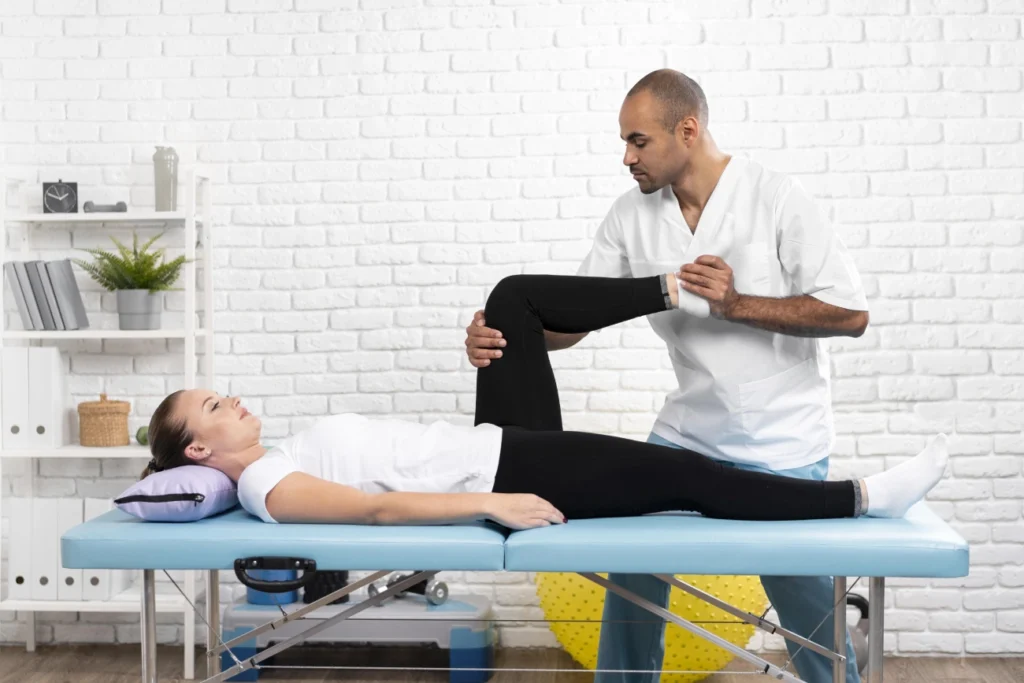
Hands-on techniques — including joint mobilizations, soft tissue mobilization, myofascial release, and muscle energy techniques — are used to reduce pain, restore range of motion, and decrease muscle guarding. These are particularly effective in the early stages of treatment when pain levels may limit a patient’s ability to exercise independently.
4. Postural Education and Ergonomic Training
For New York City professionals who spend 8–10 hours per day at a desk, postural correction and workstation optimization are non-negotiable components of treatment. We teach patients how to set up their workspace, take effective movement breaks, and maintain spinal alignment throughout the day.
5. Neuromuscular Re-Education
Many patients with lower back pain develop compensatory movement patterns — guarded walking, asymmetric weight-bearing, or an inability to hinge at the hips properly. Neuromuscular re-education uses targeted drills to restore normal, efficient movement patterns.
6. Progressive Strengthening
As pain decreases and stability improves, treatment progresses to functional strengthening exercises — squats, deadlift patterns, lunges, and loaded carries — that prepare the patient to return to their full activities, whether that’s running in Central Park, carrying groceries up a fifth-floor walkup, or competing in recreational sports.
7. Pain Neuroscience Education
Understanding that pain does not always equal damage is a powerful therapeutic tool. We help patients reframe their relationship with pain, reduce catastrophizing, and build confidence in movement — all of which are supported by strong clinical evidence.
When to Seek Professional Help
While some episodes of lower back pain resolve on their own within a few days, there are clear situations where professional evaluation should not be delayed:
- Pain persisting beyond 2–3 weeks without meaningful improvement
- Pain radiating into one or both legs, especially below the knee (possible nerve involvement)
- Numbness, tingling, or weakness in the legs or feet
- Difficulty with bladder or bowel control (seek emergency medical attention immediately — this may indicate cauda equina syndrome)
- Pain following a traumatic injury such as a fall or motor vehicle accident
- Unexplained weight loss, fever, or night sweats accompanying back pain
- Pain that worsens at night or is not relieved by any change in position
- A history of cancer, osteoporosis, or prolonged steroid use
In New York State, you have direct access to physical therapy — meaning you can begin treatment without a physician’s referral for up to 30 days or 10 visits. This allows you to get started on your recovery quickly, which the research clearly shows leads to better outcomes.
Frequently Asked Questions About Lower Back Pain and Physical Therapy
How many physical therapy sessions will I need for lower back pain?
Is it safe to exercise when my lower back hurts?
Should I get an MRI before starting physical therapy for my back?
Conclusion: Take the First Step Toward a Pain-Free Life
Lower back pain may be common, but it doesn’t have to be permanent. The research is clear: physical therapy — grounded in individualized assessment, evidence-based exercise, hands-on treatment, and patient education — is one of the most effective paths to lasting relief.
If lower back pain is affecting your ability to work, exercise, sleep, or simply enjoy life in this incredible city, we encourage you to take that first step. At LIM Physical Therapy PC in Midtown Manhattan, New York, our experienced team of physical therapists is committed to providing personalized, research-driven care that addresses the root cause of your pain — not just the symptoms.
Whether you’re dealing with a new episode of acute back pain or have been living with chronic discomfort for months or years, we’re here to help you move better, feel stronger, and get back to the life you love. Contact us today to schedule your evaluation and discover what targeted physical therapy can do for your lower back.